
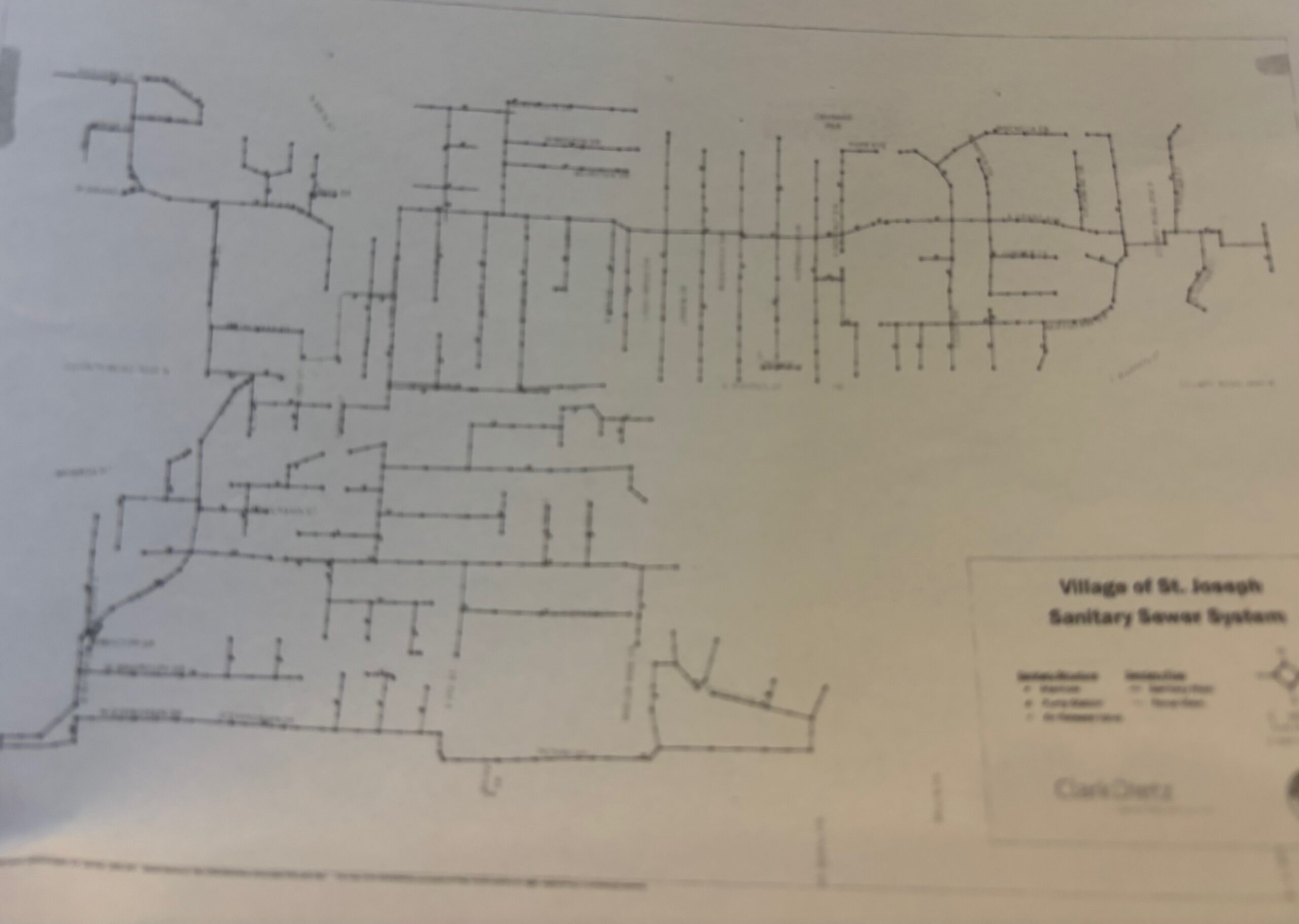
The Village of St. Joseph is exploring options to sell its wastewater system.
At a special meeting on Nov. 18, the village board authorizing a request for proposal for bids to sell the system.
The board decided to explore their options when a consultant, Gerald C. Hartman, evaluated the system and found that the cost of managing the system by an outside vendor may be done at a cost that is less than what the village could spend and user fees could be less for residents with an outside vendor.
The village has paid Hartman $33,953 since June for consulting work.
The ordinance the village board passed authorizing the RFP states “The village has considered input from the public from numerous public meetings held over the past year, together with the advice of its engineers and engaged the consulting services of engineer/system appraiser Gerry Hartman and has determined soliciting a request for proposals for the sale of the wastewater system could create an additional option to provide such services to its citizens.”
Hartman has done work for numerous other villages including Villa Grove, Gibson City and Sidney. He has also represented companies purchasing wastewater systems, such as when American Illinois Water bought wastewater treatment plants from Godfrey, Alton and Jerseyville.
The village is accepting bids until 2 p.m. on January 23.
Those interested in purchasing the system will have to provide the village with a statement of interest and qualifications, a history of their organization, a summary of their qualifications and experience, a plan for transition and operation, financial information and Illinois Commerce Commission rate information.
The plan for transition and operation must include a five year plan for the following:
Management team, future employment and salary details for current employees of these utilities, the proposed village and proposed user charge rates and fees, facility and line maintenance and replacement plans, ability to expand services if needed and the ability to participate in economic development activities.
The village is asking that bids be a single bid for all the real estate and personal property assets at the wastewater treatment plant.
At closing, the village would transfer all existing real estate and personal property to the buyer. They would also transfer all existing utility easements and all rights of way and access to the buyer. They would transfer all wastewater customer accounts, records, drawings, reports, permits and other documents.
The village is also asking for an offer of employment to the current operations personnel at not less than current salary and benefits.
The buyer would also fund the employee’s pensions.
The buyer would be assuming all responsibility to repair and maintenance of the entire wastewater system, including all underground mains and wastewater lines. The village is also asking for current customer rates to be maintained for one year after closing, subject to ICC review and approval of the contract.
Major assets
The major assets that would be sold are the wastewater treatment plant and the Elm Street project. The estimated cost of the treatment plant is $16 million. The sanitary sewer project on Elm was bid as $3.3 million.
Since the 1980s the village has spent $100,130 on force mains, $3,888,225 on gravity system replacements and $621,205 on manholes and pump stations.
The village has spent $23,909,560 since the 1980s on the wastewater treatment plant.
Hartman estimated at the first November board meeting that including equipment and other items the entire asset would be worth $24.4 million.
How they paid for it
In June 2023, the village entered into a loan agreement with the Illinois EPA.
They borrowed $19,386,138.83 at 1.24 percent interest. The state agreed to forgive $2,785, 710.28 of the loan.
The money was to be spent on the “rehabilitation of the village’s wastewater treatment plant in order to increase capacity. Specific activities entail the installation of a new influent pump, new mechanical bar screen, manual bypass screen, two oxidation ditches, one new secondary clarifier, UV disinfectant processes, expanded sludge storage, a new re-aeration structure, aerobic digester and a backup chemical feed for disinfection.
As part of the loan agreement, the village agreed to pass a resolution prior to the first disbursement on the loan committing to ensuring revenues are sufficient to offset the cost of operations, repairs, and maintenance plus debt service prior to the loan being placed in repayment status.
In June 2024, the village entered into a loan agreement with the Illinois EPA for a water pollution control loan for $4, 966,600.72. This loan funded the replacement/installation of 3.700 feet of sanitary sewer on Elm and Monroe.
Why they want to sell
The village has said that if they keep the wastewater treatment plant resident’s bills will raise substantially.
A 2018 village sewer rate study found that Fiscal Year 2025 average sewer rates were 63.30. The rate would increase gradually to Fiscal Year 2034 to 91.50.
Hartman’s study says the 2018 sewer rate study is no longer valid due to capital costs increasing, the Elm Street project, higher renewal and replacement costs and high labor costs.
Energy costs would be lower than projected due to the solar project.
With a growth of 20 house per year, Hartman estimates that the average sewer bill would raise to $103.31 in Fiscal Year 2026 and continue raising to $148.50 in 2034.
Hartman’s study estimates that several utility companies could provide lower rates to residents.
He estimates that if Aqua bought the system, their 2025 average bill would be $81.04 and go up to 103.91 by 2034. Nexus prairie would start out at $65.88 and raise to $86.14 by 2034. Illinois American Water Company would start at $48.08 and raise to $65.30 by 2034. Hartman estimates the village have to raise the base rate to 148.50 by year 2034 to cover expenses.
How this happened
The wastewater treatment plant was built in 1972. Previous administrations opted not to expand the sewer plant. It eventually reached capacity and no new homes could be built. Houses were then built outside the village limits with septic tanks.
The Illinois EPA eventually told the village that they needed to upgrade the plant. The board then decided it made better financial sense to replace the entire plant and expand it to accommodate growth.
The bid that the village approved was for $19.3 million.
That would result in a $1 million loan payment yearly until 2029 and then a $860,000 loan payment until 2045.
Mayor Jim Page said that the “village has reached a budgetary inflection point.”
Page said selling the system would allow the village to pay off all its infrastructure debt and have funds left over to spend on other projects.
“If the system is retained, then consideration of a rate increase will ensue,” he said. “Obviously, the residents of St. Joseph would object to a significant rate increase.”
The money
In Fiscal Year 2025 the Sewer Fund had revenue in total of $9,991,942.
$8.7 million came from IEPA funds for projects and $1,105,593 came from sewer charges.
In Fiscal Year 2026 the budget estimates $16,415,500 in revenue but $15 million comes from IEPA funds for projects.
It is estimated that the village will collect $1.3 million in sewer charges.
In Fiscal Year 2025 the village spent $131,211 on wages for sewer operators plus $32,328 for a part time sewer operator. They spent $25,931 on health/life benefits, $11,021 on payroll taxes and $20,000 on liability insurance. They spent $8,000 on postage, $10,000 on permits, $93,000 on utilities, $8.7 million on IEPA projects, $443,000 on a sewer bond payment, $214,148 on sewer plant project engineering, $215,819 on the Elm Street project, $265,663 on solar array expenses, $24,400 on sludge hauling, and $40,000 on sewer chemicals.
Total expenses were $10,474,927.71. The sewer fund had a deficit of $482,984.90.
In Fiscal Year 2026 the village expects to have revenues of $16,415,500, the majority of which comes from a $15 million IEPA payment for projects.
However, they have budgeted expenses of $21,441,319.
This includes $20,000 in miscellaneous expenses, $85,000 for lateral repairs, $12,500 in engineering costs, $18 million in IEPA project costs, $1,197,844 for a sewer bond payment, $10,000 for sewer building repairs, $50,000 for lift station repairs, and $916,539 in solar array costs. If these expenditures occur it would put the sewer fund in the red by $5 million.




















You must be logged in to post a comment.